

Service & Dates
RAF Police NCO 2004 – 2023
Postings
RAF Brize Norton | General Police Duties & Air Transport Security (A/Cpl)
British Forces Cyprus (Dhekelia Garrison) | General Police Duties (A/Cpl)
MOD Southwick Park | Instructor for RAF Police and RMP Initial Courses (Cpl)
RAF Henlow | Instructor for RAF Police Reservists | Tactical Policing (flying all over the world guarding contentious freight and picking up military passengers) | Instructor for Op HERRICK Pre-Deployment Training for RAF Police (Cpl and A/Sgt)
RAF Halton | Counter Intelligence Operative / Team Leader (Sgt)
AFCO London | Office Manager RAF Recruiting (Sgt)
Northwood HQ | Protective Security & Counter Intelligence (Sgt)
RAF High Wycombe | Diversity & Inclusion (Sgt and stayed on when I was promoted to FS)
Tours / Detachments
Iraq | Op TELIC in 2007 and 2009. Force Protection duties.
Afghanistan | Op HERRICK 2012-13. Afghan Prosecution Support Section.
UAE/Oman/Qatar | Op KIPION 2016-17. Counter Intelligence Field Team.
Multiple exercises / trips around Europe and USA – somehow managed to avoid the Falkland Islands and Kenya!
Additional Info
I have been a D&I Adviser since 2015, a Trauma Risk Management (TRiM) Practitioner since 2021, inaugural committee member (Comms Lead) of the RAF Disability & Carers Network, and was the RAF Indoor Rowing Team Manager for a short spell. Team UK bronze medallist (indoor rowing) at Invictus Games Dusseldorf 2023, aspiring to be selected for IG Vancouver Whistler 2025, ideally as Vice-Captain Team UK. Currently hold 9 British Records in indoor rowing in my para category (women 30-39 PR3 PD). I also run a blog, predominantly about my struggles with Multiple Sclerosis (MS), Attention Deficit Hyperactivity Disorder (ADHD) and mental health and how I use sport and physical activity to manage myself.
Tell us a bit about yourself, your background, and your current role?
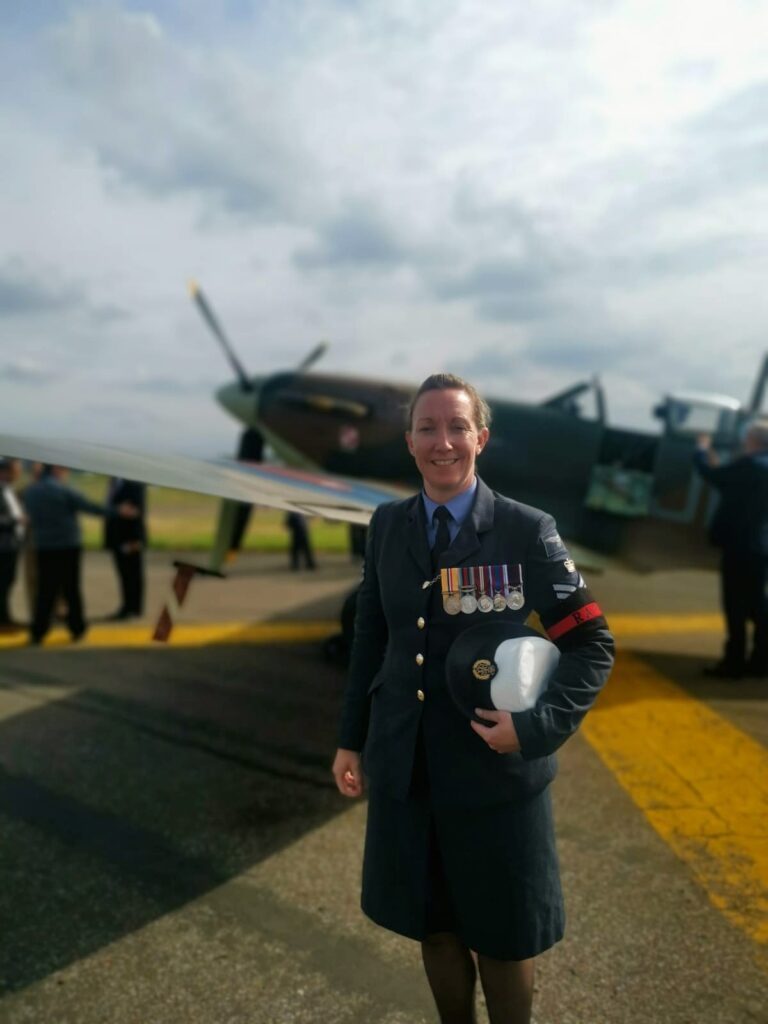
I joined the RAF as a teenager and spent almost 19 years serving, before I was eventually medically discharged – which was a bittersweet moment. I was badged as RAF Police but have undertaken a multitude of roles in addition to law enforcement, such as protective security, counter intelligence, recruiting, and instructing. My last role was at HQ Air Command in the Diversity & Inclusion Team; something which as a gay woman with a disability, who grew up working class has always been important to me. Since leaving the RAF in June 2023, I have been working as the D&I Officer at the Royal British Legion.
Did you ever sit down and plan your career?
When I was in the RAF, I always knew what jobs I wanted within the next three-to-five-year window and was proactive about gaining the experience and qualifications needed for them. Luckily, I was usually successful in being assigned to roles that I would find interesting and be able to add value to. As for what’s next, I am enjoying my role at the RBL so far, but also have a couple of ‘side hustles’ on the go which may prove fruitful. I’m only in my first six months of civvy street and there are so many opportunities and things that interest me, that it is hard to narrow it down to just one!
What Things You Do in Your Spare Time Enable You to Be a More Effective Leader in Your Professional Life?
Personal and professional development. I’m finally finishing a Post Graduate Certificate in Change Management through the University of Brighton – the first two modules of which were fully funded by the MOD’s University Short Course Program. I completed undergraduate studies via the RAF at the age of 30 and found that needing to always cite a counter argument meant that I could apply this to enhance any decision making in work.
I am also an advocate for inclusive and adaptive sports and try to train five or six times a week. I find that a morning workout prepares me better for the working day and that physical fitness contributes to better mental health. I was fortunate enough to be selected to represent Team UK at the Invictus Games Dusseldorf 2023, and this time round had no position of responsibility so being able to switch off from thinking about other people (apart from being a good team mate of course) and purely focus on what I wanted to achieve in rowing and powerlifting was also a good ‘off’ switch for me. I am part of the Every Body Moves Lived Experience Advisory Board who meet regularly to shape the direction of the charity, which was borne from Paralympics GB.
What has been the most significant challenge you’ve faced in your career, and how did you overcome it?
My health. I have had multiple sclerosis (MS) on my medical records since 2010, and for the first decade it was a ‘nuisance’ as opposed to a disability. It was that minor that I was able to deploy on Operations HERRICK (Afghanistan) and KIPION (UAE). A relapse at the end of 2019 saw me begin to struggle with nerve pain and fatigue, both physically and cognitively. Trying to still keep up at work as a Sergeant who was aspiring to reach the rank of Flight Sergeant, meant that almost all of my limited energy was being used on work, with nothing left in the tank for social and familial commitments. I am more confident in disclosing my struggles now and since opening up about how MS affects me to my team, I’ve been met with empathy. In some ways I’m still trying to overcome it. I thrive in fast-paced, chaotic, and challenging environments, but recognising the stress that comes with it flares my MS up, I’m still learning how to get the right balance of excitement and innovation but still look after myself at the same time!
What qualities do you think are lacking among today’s leaders?
Vulnerability and empathy. We’re getting better with the latter, which is achieved through story telling and panels. One thing that I found across both Defence and RBL, is that often leaders are over-worked as it is, so attending awareness events on D&I or staff networks are not seen as a priority. I know there was mixed opinions, but I liked when the Army launched Operation TEAMWORK, and ensured that everyone stopped business as usual and took a day to learn about culture and D&I issues. This is a great example of senior leadership buy in.
How do you continue to grow and develop as a leader?
Listen; to your leaders, your followers, and your peers. Take on feedback. I’m naturally an extrovert and curious, so I like to learn about people that I work with and understand what motivates them individually – that way I can allocate the right task to the right person.
What’s the most important risk you took and why?
Publishing a blog post on DefNet for International Day of People with Disabilities in 2020, when the theme was ‘invisible disabilities’. It was a big gamble as I wasn’t ‘out’ to many people about my MS and there was a lot of personal information on there about how it affects my bladder and co-ordination. I was a bit apprehensive that it would show me as weak. What I was met with were people in similar situations to me, lots of them, and from that I created my own personal support network. It also encouraged me to join the inaugural committee of the RAF Disability & Carers Network as the Communications Lead. By me being open about my struggles, I’ve found that it not only gives a sense of support to others who are struggling, but also educates people who don’t have disabilities to think about inclusivity and accessibility.
How do you handle criticism or negative feedback as a leader?
At first, I will feel disappointed, as I always want to do my best – and I hate conflict. Then I’ll reflect on the feedback, corroborate others’ thoughts if it’s from a single source and act upon it. Asking other people for feedback too may reveal further points to improve on, or it may be that the criticism was unwarranted in the first place.
How have you built confidence and/or resiliency over the course of your career?
I naturally lack self-confidence but am very good at masking! I’m fortunate that in most of my workplaces I’ve had other people to bounce off and bring the best out in each other. Getting feedback and thanks goes a long way for me and reassures me that I’m either doing well at my job, or that I’m not, but I can do xyz to change it. If I am passionate about a certain topic, I am naturally more confident, so working within the D&I space and influencing ethical leadership are where I feel more self-assured, but sometimes the imposter syndrome is still very real.
What do you think is the most important piece of advice for women who want to pursue a career as a leader?
Be yourself. Don’t act in a certain way that conflicts with your beliefs, values, or personality. Often in workplaces which are predominantly men, the stereotypical ‘male’ traits tend to be looked at as strengths. Diversity in leadership is just as important as anywhere else. If you’re in the right workplace, it will allow you to pursue your strengths and not have to conform to an archaic view of what a ‘good’ leader looks like. Also, mentoring – get someone who is different to you and not usually someone you would tend to socialise with, to mentor or reverse mentor you.


Responses