
Tell us a bit about yourself, background, and your current role.

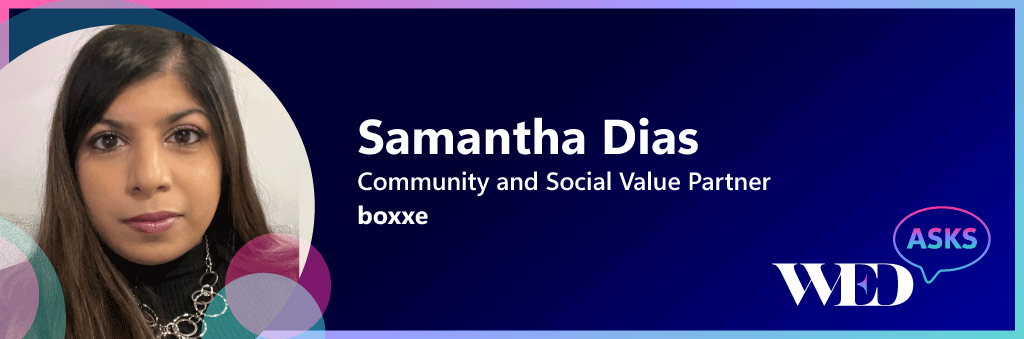
I’m Sam Dias, boxxe’s Community and Social Value Partner. With a degree in Business Ethics and a Master’s degree in Corporate Social Responsibility and Sustainability, I’m incredibly passionate about giving back to the community.
As Community and Social Value Partner at boxxe, I manage boxxe’s relationships with charities, help enable our people to use their 11.5 paid community days provided by boxxe and ensure social value is delivered to our customers across the UK.
Did you ever sit down and plan your career?
As a child I wanted to work for a charity supporting stray dogs and cats. Initially I was sure I would work for a charity. However, I ended up taking a corporate social responsibility course in university and over time recognised the importance of being that person within a company who advocates for the community and ensures it’s considering its social responsibility.
After I graduated with my Master’s degree, I ended up at a Software company and have been in the tech industry since. It’s not an industry I expected to be in but it’s one with varied opportunities for all.
How do you continue to grow and develop as a leader?
The way I continue to grow and develop is through pushing myself out of my comfort zone. As an introvert, during the early stages of my career (in my 20s) I was happy to stay within the confines of my comfort zone. Over time (as I’ve gotten older and wiser) I’ve realised there’s no way you can grow and develop if you don’t push yourself out of that comfort zone. This can be as simple as attending an event you would normally have shied away from, taking on an additional project, or joining one of your company’s employee resource groups.
What advice do you wish someone had given you earlier in your career?
One of the most important lessons I’ve learned in my career is to put yourself first. I wish someone would have stressed how important work-life balance is! I’ve been in roles in the past where the culture meant working through lunch breaks and overtime with no additional pay. Of course, it’s not about the pay- It’s about what those additional hours of unpaid work take from you; Valuable time with friends and family.
So, in my working life today, I tend to check in with colleagues I regularly work with to ensure they’re okay and logging off on time. In addition, being a mental health first aider means I’m able to spot when something isn’t right.
Having a workplace that values employee wellbeing is a bonus. At boxxe all staff are given a wellness hour every month. The wellness hour is a dedicated 60 minutes to focus on your wellbeing and do something that promotes positive wellbeing for you. Self-care looks different to everyone; Colleagues at boxxe have used their wellness hours to get out in nature, meet up with family and friends, get their hair done etc. I used one of my monthly wellness hours recently to log off earlier on a Friday and get a facial!
As a leader, what do you consider to be one of the most difficult obstacles you’ve faced?
One of the most difficult obstacles I’ve faced and may continue to face in the future (along with other ESG/ Social Value/ CSR professionals), is employee and/ or exec level buy in when it comes to community and social value.
Many people still have the view that business is business and that there’s no real benefit or need for businesses to engage in community work. This view has sometimes hindered progress and meant we had to limit the amount of community work we did. In recent years we’ve seen an increasing number of customers prioritise social value and continually express its importance to them. As a result, we’re starting to see more people understand the value of social value and its less of an uphill struggle.
What would you say are the most important leadership values to you?
There are many important leadership values, but the most important to me are communication, commitment, respect, and empathy.
The value that sets great leaders apart though is empathy. During the tough times (and even in the good) people look to leaders for empathy. I recently read an article on leadership and the following quote resonated with me, “While traditional leadership typically calls for individuals to leave their personal lives at home, empathy allows leaders to acknowledge and accept people for what they are: human.”
How have you built confidence and/or resiliency over the course of your career?
When you work within ESG it comes with the territory that when things get tough at some organisations due to restructuring for example, your team is likely one of the first to go through consultations. I’ve been through three redundancies now and it’s a challenge to not take it personally when that happens to you.
One of my strengths is staying positive. It’s the positivity that helped me through those tough times and will continue to help me in the future. Those periods after the three redundancies were perfect opportunities for me to pause, reflect and take a breather before the next opportunity came along.
What do you think is the most important piece of advice for women who want to pursue a career as a leader?
Stay true to yourself and don’t let anyone tell you you’re not capable of being a leader. I’ve overheard many people in the past saying leaders need to be a certain way. You don’t need to fit into a box. Be unashamedly you!
What do you think are the biggest challenges facing our industry / Sector today, and how do you see us overcoming them?
In my opinion, the lack of women and people from ethnic minorities in the industry is the biggest challenge.
Through the work of Women Empowering Defence and other great organisations such as TC4RE (Technology Community for Racial Equality) across the UK and the world, much progress is being made. By playing an active role in these organisations and the discussions taking place within them, we’re ensuring that more people have visibility of the varied careers in tech, where everyone is welcome.
In addition to involvement with organisations promoting diversity, equity, and inclusion, it’s important to keep the dialogue going internally. This may be through forming a diversity, equity and inclusion business resource group or ensuring diversity is a topic discussed regularly at exec level.


Responses