
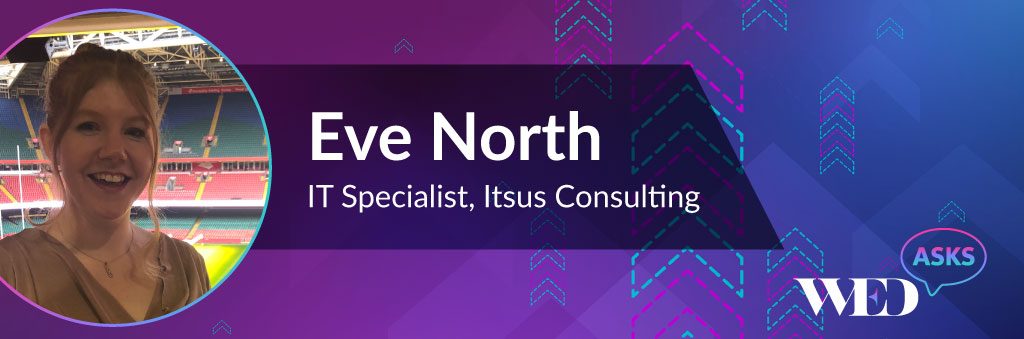
Tell us about yourself, your background, and your current role.

I’m an ICT Specialist, which at ITSUS means I manage our supply chain to our vendors including partnerships, and our reselling activities. I get to learn about new products, interact with customers, support marketing campaigns, all sorts. I chose this job for its mix of technical and business components; I wanted to learn about how business’ run but I was also aware that my brain likes a little techy stuff too. Turns out business decisions take a lot of problem solving, my brain loves it. I’ve been in this role for 3 years and am lucky that it has evolved and grown with me, so I haven’t felt too stalled.
Before this I worked a year at the Office for National Statistics (ONS) as a software developer in their prices team i.e., for the CPI and CPIH indices. The ONS has a multitude of opportunities for those so inclined, including working with other teams and fast tracks to more senior roles. The economics division are very supportive of training and being a big company there is a lot on offer. I enjoyed helping other teams with my programming skills and trying new things in the monthly training morning. I just wasn’t that into being a programmer as a career so thought I’d change roles a try something different.
My training, and original career path, was as a research scientist in astrophysics. I studied at Cardiff for both my Master of Physics and PhD, and now I’ve set up my life in South Wales. I was always fascinated by science, especially astrophysics, so doing degree in it felt like the natural path for me. I loved learning about physics, taking it back to the basics of can you measure gravity and derive equations from first principles was great fun for me. But when it came to doing my own research, I wasn’t quite as sure and felt the researcher lifestyle wasn’t for me. I am glad I did it and have found the skills I developed transfer well; I mean less so the algebra but more the people skills and project management.
At the university open days we did get some worried parents asking if there would be jobs after astrophysics and I always said the skills transfer well but for now if they have something they like studying they should go for it. It applies to anyone, for any job post-degree you’ll have more skills than you think for it.
Outside of work I enjoy hiking, swimming, drinking real ale, cooking, and gardening. I also volunteer with the Girl Guides. It never stops amazing me some of the ideas they come up with and how open their minds are. I really enjoy giving them a space to be themselves without judgement or the worry that school often seems to bring.
Did you ever sit down and plan your career?
Not exactly a plan and not this career path, but I did have general ideas about careers. Originally, I wanted to be an astronaut or research scientist. During my PhD I decided that career wasn’t for me and started thinking about other options. I started with things using the obvious skills I’d learnt, software development, but then thought more about what I enjoyed, outreach, problem solving, and not software development. As I mentioned above, I also wanted to learn about business’ and how they work.
When you began your career, did you ever imagine that you would be in a leadership role?
I guess I hoped I would move up the career ladder/jungle gym and be in leadership. I do quite enjoy organising etc. But when I joined this new area, I did think it would take me a while to find my feet and feel confident enough to lead. This interview is one of the first times I’ve really thought of myself as a leader, it creeps up on you but looking back I see it.
What inspired you to pursue a career in technology, and how did you get started in this field?
I’ve always enjoyed science, learning about the universe and how it works. At GCSE wanted all the science I could and went from there. Something I wasn’t aware of when I started my degree is that a big part of astrophysics research is using computer programmes to analyse and model real life observational data. So I now have software development skills that I hadn’t aimed at but are a great skill to have and are why I’ve stuck to IT related roles.
Can you share a significant milestone or project in your tech career that shaped your journey as a leader?
Passing my PhD was a great external validation of my technical ability, it showed I could manage my own time, research a novel idea and talk to others about that research. This made me more confident in going out into the “real world” of jobs.
This year within our company there has been a lot of change and therefore a lot of hiccups too, being involved in that, and the lessons learnt has been great and I find myself being able to critique the company about its leadership. This has made me think more about being a leader and where I might like to go with my career.
During university I began thinking about and getting involved in mental health promotion and the women’s rights movement. I’ve been to quite a few events and am always inspired and learn new techniques about being more confident and progressing. It’s a bit cliché to say in this interview but the recent Young Women in Tech Day held by WED was brilliant for me. There was structured networking, so I met people and already had a purpose in talking to them. It also had group problem solving which is mostly great fun. I try to use these events to build myself up and progress my journey, they are great for collectively building each other up.

As a young leader in tech, what are some of the most exciting trends or innovations that you’re passionate about?
I’m really enjoying seeing diversity being celebrated within the tech sector. It’s great to see the sector, and wider society realise that diversity is better for us all and really needed for us to make the world better. We’ve a long way to go but it’s progressing (mostly).
From a technical view I’m excited about smart buildings and cities, they offer so many opportunities in particular increased inclusivity and sustainability which I am passionate about.
What challenges did you face when first stepping into a leadership role, and how did you overcome them?
Confidence and organisation, I’m not very confident or outspoken so making sure I lead the meeting I’m meant to or that I argue my case fully is something I’m working on. In meetings making sure I know what my purpose in it and that I achieve that is also key, e.g. if I need a piece of information I should ask or if I’m the authority on the product I should share my expertise.
In terms of organization, I can be a bit scatterbrained so making sure I’m that bit more on top of things or better prepared before meetings is crucial to being useful and productive. I often have to go to a webinar/meeting, report back and feed it into our business plans, so I need to have my thoughts well organised when reporting back. Einstein (I believe) once said that if you can’t teach it, you don’t really understand it, so I make sure I understand what I’m trying to explain before I share it.
What advice would you give to other young women looking to start or grow their careers in tech?
Keep in mind your passions, and make sure you follow them.
Relationships and your network will be invaluable so work on them and use them when you need to.
You don’t have to be bullish or loud, knowing when to speak up is key – but do speak up.
How have you developed your leadership skills in such a fast-paced and evolving industry?
The same skills are appreciated everywhere, so don’t worry about the pace of change. Getting to know your niche is good, what do you bring to meetings or a team (is that what you want to bring) and develop being great at it. Also remember you aren’t expected to know everything.
Watching different leaders, what do they do that works, that I like and can emulate, and what doesn’t work. But also looking at your peers and are there things to emulate or things to not do.
What leadership qualities do you think are most essential for success in tech, and how do you cultivate those qualities in yourself?
Compassion, openness, if you don’t know say so, getting the right experts in the room, understanding how tech/science works i.e. the process.
Remembering I don’t have to know it all and knowing my colleagues’ skills/roles so that I can get the experts in the room and use their skills/knowledge. I haven’t done it in a while, but I do find journaling can be helpful to reflect on how I’ve been doing and then writing down what I want to do, or how I want to act can be helpful to put it into action.
How do you manage imposter syndrome or self-doubt, especially in a male-dominated field like tech?
Remembering you belong and have something to add, preferably before a meeting or project work out what your purpose and USP for that event and work on that, remember that, and then go forth and add your piece.
I did have a lot of imposter syndrome/self-doubt which I’m working on, doing little things to be a bit vulnerable helps to build up.
How do you handle situations where you’re the only woman in the room, especially in leadership or decision-making spaces?
As above, remember your USP, and that everyone is just as “clueless” as you. I have had speakers notice me and so add “and women” when talking about the room etc. which can feel awkward. Little things like making sure you shake hands (if that is the greeting) can make you part of the meeting.
Can you share an experience where you had to overcome a significant obstacle or bias in your role as a young woman leader in tech?
My own obstacle is talking to people and making a network, I’m shy and can be unsociable. So, working on networking and setting boundaries that work for social situations has been great.
But from other people it’s mostly the standard assumptions about women, that we’re not into nerdy things or that we need cheek kisses with a handshake. I often find people change their language around women, as if we have delicate ears, so trying to dispel those microaggressions where I can.
I’ve been lucky nothing major has happened to hold me back.
And finally, what advice would you give to young women looking to build strong professional relationships in the tech industry?
Where you are comfortable, share personal things e.g. interests as this will help you connect and be more human, some of these might surprise you. Have boundaries and enforce them. You can nerd out. Finding a way to help someone or bring them an opportunity is often good, as opposed to just seeing how they can help you. Being up for being social, where you can, so many relationships are secured outside of the office. I’ve heard it said elsewhere, listen to understand not to reply.


Responses